

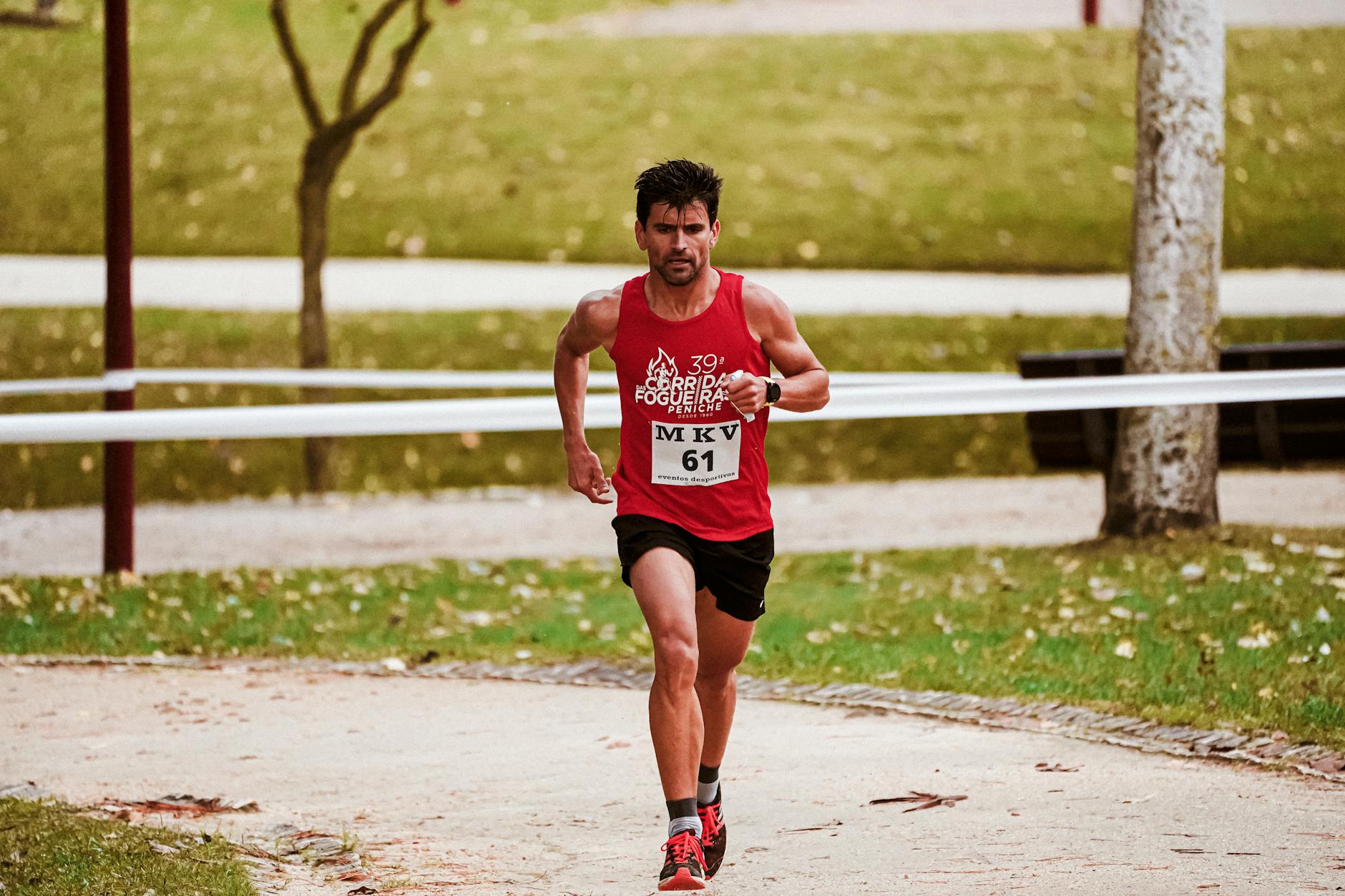
Most recreational runners can safely increase their cadence by 5% per week using short intervals with a metronome, starting at 10 minutes and building to full easy runs over four weeks. Research shows that moving toward 170-180 steps per minute reduces impact forces by 3-8% per 5% cadence increase, lowering injury risk without requiring you to run faster—the key is maintaining the same easy pace while taking quicker, lighter steps.
Why does running cadence matter for injury prevention?
Running cadence—the total number of steps both feet take per minute—directly influences the impact forces your joints absorb with each stride. Biomechanics research consistently demonstrates that runners with cadences below 160 steps per minute experience higher ground reaction forces, longer ground contact times, and greater vertical oscillation, all of which increase loading on the knees, hips, and lower back. The widely cited 170-180 spm range originated from coach Jack Daniels’ observations of elite runners in the 1980s, though individual variation exists based on height, leg length, and running speed.
Lower cadence correlates strongly with overstriding—landing with your foot well ahead of your center of mass—which creates a braking effect and sends shock waves up the kinetic chain. Each heel strike at low cadence can generate impact forces 2-3 times body weight, concentrated in the knee joint. Conversely, higher cadence promotes a midfoot strike closer to your center of gravity, distributing forces more evenly across muscle and tendon rather than bone and cartilage.
It’s crucial to understand that cadence is individual. Taller runners naturally take fewer steps per minute than shorter runners at the same pace due to longer leg pendulums. A 6’3″ runner might run efficiently at 168 spm, while a 5’2″ runner may naturally sit at 182 spm. The goal isn’t hitting a magic number but avoiding the injury-prone zone below 160 and reducing overstriding mechanics.
The biomechanics: shorter strides mean lower impact forces
Each 5% increase in cadence typically reduces peak tibial acceleration and patellofemoral joint stress by 3-8%, according to gait analysis studies conducted over the past decade. The mechanism is straightforward: when you take more steps per minute at the same speed, each individual stride covers less distance, which means your foot lands closer to your body’s center of mass. This geometry change reduces the braking force vector—the horizontal deceleration that occurs when your heel strikes ahead of your hips—and allows your muscles to absorb impact through eccentric contraction rather than transmitting shock directly to bone.
The Achilles tendon and calf complex particularly benefit from this redistribution. While higher cadence does increase the loading rate on these tissues initially, the total load per stride decreases as stride length shortens. Studies measuring Achilles tendon strain show that moderate cadence increases (5-10 spm) shift stress away from the patellofemoral joint—a common site of runner’s knee—and toward the more robust posterior chain musculature designed for repetitive loading.
Vertical oscillation, or how much your body bounces up and down with each step, also decreases with higher cadence. Less vertical movement means more of your energy propels you forward rather than fighting gravity, improving running economy over time. Runners who successfully increase cadence from 160 to 175 spm often report feeling “lighter” and less pounded after long runs, a subjective experience backed by force plate data showing reduced peak vertical ground reaction forces.
What your current cadence reveals about your form
Measure your baseline cadence during an easy-paced run by counting how many times your right foot strikes the ground in 30 seconds, then multiply by four to get steps per minute for both feet. Most running watches now display real-time cadence, but a manual count during a relaxed mile provides an accurate snapshot without the distraction of technology.
Interpretation guidelines for recreational runners:
- Below 160 spm: Strong likelihood of overstriding with excessive braking forces; high injury risk for knees and hips; priority should be gradual cadence increase
- 160-170 spm: Moderate efficiency range; small improvements (5-8 spm) typically reduce injury risk without major biomechanical overhaul
- 170-180 spm: Efficient range for most runners; further increases depend on individual comfort and injury history
- Above 185 spm: May indicate excessive vertical oscillation or “bouncing”; check that you’re driving forward rather than up
Apply the height adjustment: taller runners (over 6’0″) can subtract 5-10 spm from these ranges, while shorter runners (under 5’4″) may naturally add 5-10 spm. A 6’1″ runner with a current cadence of 166 spm isn’t necessarily overstriding, but a 5’5″ runner at the same cadence likely is. Watch for the visual cue that matters most: whether your foot lands beneath your knee or extends out in front of your body at ground contact.
The 4-week safe cadence increase protocol
The safest progression increases cadence by 5% per week through structured intervals that gradually expand in duration, giving your neuromuscular system and connective tissues time to adapt without overload. If your baseline cadence is 160 spm, your four-week targets would be 168 spm (week 1), 176 spm (week 2), 180 spm (week 3), and then holding 180 spm for the entire easy run by week 4. After completing a four-week cycle, maintain the new cadence for two full weeks before considering another increase—adaptation happens during consolidation, not constant progression.
Use a metronome app to provide external auditory cuing during the adaptation phase. Soundbrenner Metronome and Pro Metronome both allow you to set precise beats-per-minute and run with earbuds, syncing your foot strikes to each beep. Set the app to your target cadence (not double-time—each beep represents one foot strike, so a 170 spm target means 170 beats per minute). The audio cue trains your nervous system more effectively than watching a number on your wrist, freeing your attention for terrain and effort management.
Structure each week around your easy run days—never attempt cadence changes during hard workouts, tempo runs, or long runs exceeding 90 minutes. Easy runs provide the perfect training ground because the low intensity allows you to focus on form while accumulating enough volume for motor pattern learning. Schedule cadence-focused runs on separate days from speed work to avoid compounding stress.
Week 1-2: Short intervals with auditory cues
Begin with a 5-minute warm-up at your natural cadence to establish baseline feel and loosen up. Then run a 10-minute interval matching the metronome beep at your target cadence (+5% from baseline), followed by 5 minutes at natural cadence to recover neurologically. Repeat this cycle once: another 10-minute interval at target cadence, then finish with 5 minutes naturally. Total run time is approximately 35 minutes, with 20 minutes spent practicing the new rhythm.
The critical cue during intervals is “quick, light steps” rather than “run faster.” Your pace should remain exactly the same as your warm-up—use rate of perceived exertion or heart rate to confirm you’re still in Zone 2 or conversational effort. New runners to cadence work almost universally speed up during their first interval because quicker turnover feels faster. Combat this by checking your watch every 2-3 minutes to verify your pace hasn’t crept up more than 10-15 seconds per mile from your intended easy effort.
During week 2, maintain the same interval structure—10 minutes on, 5 minutes natural recovery, repeat—but increase your focus on eliminating the metronome dependency during the final 2 minutes of each interval. Turn the volume down slightly and see if you can maintain the rhythm by feel. This progressive cueing withdrawal sets up week 3’s longer intervals.
Week 3-4: Extending the new rhythm
Increase interval duration to 15 minutes in week 3, using the same pattern: 15 minutes at target cadence with metronome, 5 minutes natural, 15 minutes at target cadence. By this point, the rhythm should feel less foreign, though still requiring conscious attention. Start weaning off the metronome during the final 5 minutes of each 15-minute interval—turn off the audio but leave your watch’s cadence field visible to provide feedback without external cuing.
Week 4 represents full integration: attempt your entire easy run (40-60 minutes) at the new cadence without the metronome. Use the audio for the first 10 minutes if needed to “lock in” the rhythm, then shut it off and run by feel. Check your watch’s cadence display every 10 minutes to see if you’re holding within 3 spm of target. Deviation of 5-8 spm indicates you need another week of interval work before the pattern becomes automatic.
The most common mistake during weeks 3-4 is abandoning pace discipline as intervals lengthen. Your easy pace must remain truly easy—conversational, nose-breathing comfortable, subjectively “boring” in intensity. If you find yourself breathing harder or unable to speak in full sentences, you’ve conflated cadence increase with speed increase. Slow down immediately. Higher cadence should initially feel harder at the same pace because you’re fighting established motor patterns; this sensation normalizes after 6-8 weeks as efficiency improves.
What mistakes cause injury when increasing cadence?
Five specific errors account for most cadence-related injuries, each stemming from impatience or misunderstanding the biomechanical demands of changing your stride pattern. First, progressing faster than 5% per week overloads the calf-Achilles complex before eccentric strength adaptations occur, frequently causing Achilles tendinopathy or soleus strains. A runner jumping from 160 to 180 spm in two weeks increases loading rate by 12.5%, asking tissues to adapt three times faster than physiological remodeling permits.
Second, attempting cadence changes during hard workouts compounds mechanical stress. Tempo runs and interval sessions already elevate ground reaction forces through higher speeds; simultaneously altering your stride pattern while running near lactate threshold overwhelms your body’s adaptive capacity. Cadence work belongs exclusively on easy days during the 4-6 week adoption window.
Third, consciously forcing a shorter stride length—actively pulling your foot back mid-air or “chopping” your steps—creates hip flexor tension and disrupts natural gait mechanics. Shorter strides should happen passively as a result of quicker turnover. Focus solely on faster foot turnover at the same pace; stride length will automatically shorten by 2-4 inches without deliberate manipulation.
Fourth, increasing vertical oscillation while raising cadence wastes energy and increases impact forces despite quicker turnover. Some runners interpret “quick steps” as bouncing more, driving their knees higher and pushing off the ground more forcefully upward rather than forward. The correct cue is “skim over the ground” or “run quietly”—you should hear softer, quicker footfalls, not louder, more percussive thuds.
Fifth, ignoring early warning signs of tissue overload leads to chronic injuries. Mild calf tightness or Achilles stiffness in the first 10 minutes of a run that resolves with warm-up is expected during weeks 1-3. But persistent soreness lasting more than 48 hours, morning Achilles pain requiring 10+ minutes to walk normally, or sharp mid-run pain all signal you’ve exceeded tissue tolerance and must regress to the previous week’s cadence.
The calf and Achilles adaptation window
Higher cadence fundamentally changes how your calf and Achilles tendon complex handles load by increasing the frequency and rate of eccentric muscle actions during the stance phase. When you land with a shorter stride closer to your center of mass, your ankle dorsiflexes more rapidly and your calf muscles must decelerate that motion eccentrically—lengthening under tension—with each step. While this reduces impact forces upstream at the knee and hip, it concentrates more demand on the posterior lower leg.
Collagen remodeling in tendons requires 72-96 hours between loading stimuli, and full adaptation to a new loading pattern takes 3-4 weeks minimum for the Achilles tendon’s relatively poor blood supply. This timeline dictates the 5% weekly progression rule: you’re giving the tendon a full week to synthesize new collagen fibers aligned with the altered stress direction before adding another increment. Rush this process and you risk reactive tendinopathy, where the tendon becomes thickened, painful, and prone to microtears.
Warning signs you’ve exceeded the adaptation window include:
- Morning Achilles stiffness lasting more than 10 minutes after waking
- Pain that worsens during a run rather than improving after warm-up
- Tenderness when pinching the Achilles tendon 2-4 cm above the heel insertion
- Calf tightness that doesn’t respond to stretching or foam rolling within 24 hours
- Reduced ankle dorsiflexion range of motion compared to baseline
Support healthy adaptation by adding eccentric calf raises three times per week on non-running days: stand on the edge of a step, rise onto both toes, lift one foot, then slowly lower the working leg over 3-4 seconds until your heel drops below step level. Perform 3 sets of 12 repetitions per leg. This specific strengthening exercise matches the eccentric demand of higher-cadence running and accelerates tissue remodeling.
Cadence drills that reinforce the new step rate
Four specific drills accelerate neuromuscular learning of your target cadence when inserted after easy runs twice per week during the 4-week adaptation protocol. Each drill isolates different aspects of the movement pattern—foot strike timing, propulsive mechanics, auditory-motor coupling—to build automaticity faster than running alone.
Strides with metronome (6 × 20 seconds): After completing your easy run, set your metronome to your target cadence and perform six 20-second surges at approximately 5K effort while matching each foot strike to the beep. Take 60-90 seconds of walking recovery between repetitions. These short bursts train your nervous system to maintain higher cadence even at faster speeds, building the skill of decoupling turnover from pace. As fitness improves, the same 20-second surge will cover more ground at the target cadence, proving economy gains.
Downhill running at +5 spm above target (4 × 2 minutes): Find a gentle 2-3% grade decline and run four 2-minute repetitions at your target cadence plus 5 steps per minute—if you’re training 175 spm, run downhills at 180 spm. Gravity naturally increases turnover, making the faster rhythm feel easier to achieve. This drill provides a preview of what your next progression increment will feel like while building confidence that higher cadence is sustainable. Walk back uphill for full recovery between reps.
Barefoot treadmill running at +10 spm above target (5 minutes): Once weekly, finish an easy run with 5 minutes barefoot on a treadmill at your target cadence plus 10 spm. The lack of cushioning forces immediate midfoot striking and naturally shortens stride length, providing sensory feedback about optimal foot placement that transfers to shod running. Set the treadmill to very easy pace (2-2.5 mph slower than normal easy pace) to keep effort conversational. This drill is contraindicated if you have any active foot injuries.
Double-time march drill (3 × 1 minute): While walking as a warm-up or cool-down, set your metronome to double your target running cadence (for 175 running spm, set metronome to 350 bpm). March in place or walk forward, striking the ground with alternating feet on each beep. This exaggerated rhythm at half speed trains the neural firing pattern without impact stress, similar to how musicians practice difficult passages slowly before attempting performance tempo. Perform three 1-minute bouts with 30 seconds of normal walking between.
Insert these drills strategically: strides after Tuesday and Thursday easy runs, downhill reps once weekly on a moderately hilly route, barefoot treadmill work as a Friday shakeout, double-time march during any warm-up. Total additional time commitment is 15-20 minutes per week, but the motor learning transfer to your regular running is worth the investment during the 4-6 week adoption phase.
How long does it take to make higher cadence feel natural?
Most runners achieve conscious competence—the ability to hold target cadence with focused attention but not yet automatically—within 4-6 weeks of consistent practice following the interval protocol. Full automaticity, where your nervous system defaults to the new rhythm without conscious cueing, requires 10-12 weeks of regular exposure. This timeline aligns with motor learning research showing that complex movement pattern changes demand 8-10 weeks minimum for neuromuscular reprogramming, with individual variation based on training frequency and initial skill level.
The process unfolds in stages. Weeks 1-3 feel effortful and unnatural, requiring constant metronome feedback and mental attention to maintain rhythm. You’ll drift back to old patterns within seconds of distraction. Weeks 4-6 represent a transition phase where the new cadence feels more familiar during dedicated practice but hasn’t yet infiltrated your default running gait—if you run casually without thinking about form, you’ll revert to baseline. Weeks 7-9 show breakthrough moments where target cadence appears spontaneously during portions of runs without deliberate cueing. By weeks 10-12, most runners consistently hit their target within 3 spm without conscious effort.
Three strategies accelerate this timeline. First, prioritize consistency over intensity—four easy runs per week at target cadence builds the pattern faster than two runs weekly even if the latter involves more total mileage. Second, incorporate varied terrain, particularly trails, which naturally increase cadence through obstacles and uneven footing; this provides organic practice without the monotony of metronome sessions. Third, remove watch distractions during cadence-focused runs by covering the screen or using a simplified display showing only cadence and time—constant pace monitoring triggers psychological pressure to speed up.
You’ll know the new cadence is “locked in” when three conditions are met: you hit target cadence within plus-or-minus 3 spm without a metronome on easy runs, the rhythm feels subjectively easier than it did in week 2, and you maintain target cadence on varied terrain including gradual uphills without conscious attention. Most runners reach this point between weeks 9-14, after which the pattern is durable enough to persist even through weeks of reduced training volume.
Should you change cadence for races versus training runs?
Yes, racing cadence naturally sits 3-8 steps per minute higher than easy run cadence due to increased velocity requiring more rapid force production, and you should allow this organic increase rather than fighting it. Elite runners demonstrate this range clearly: easy runs at 165-170 spm, marathon pace at 175-180 spm, half-marathon pace at 180-185 spm, and 5K pace at 185-195 spm. The faster you run, the more ground you must cover per minute, which necessitates either longer strides, quicker turnover, or both—and quicker turnover is the safer biomechanical choice.
Don’t artificially force higher cadence during tempo runs or interval workouts in the name of consistency. Let speed naturally elevate your step rate while maintaining the same running economy you’ve built during easy-run cadence training. Attempting to hold your easy-run target cadence (say, 172 spm) during a lactate threshold tempo often requires overstriding to maintain pace, recreating the exact injury-risk pattern you’re trying to avoid. Instead, practice race cadence during goal-pace workouts and note what happens naturally.
Target cadence zones by effort for most recreational runners:
- Easy runs (Zone 2): 170-175 spm baseline target after adaptation
- Marathon pace: 175-180 spm, typically 5 spm above easy cadence
- Half-marathon pace: 178-183 spm, about 8 spm above easy cadence
- 10K pace: 180-185 spm, requires no conscious manipulation by this speed
- 5K pace and shorter: 185-195 spm, often 10-15 spm above easy cadence
Practice your race-specific cadence during the final three weeks before goal races by including cadence checks during race-pace workouts. Run 3 × 1 mile at marathon goal pace and note your natural cadence in the third interval when rhythm is established—this number becomes your reference range for race day. If your natural marathon-pace cadence is 178 spm, plan to see 175-180 spm on your watch during the race without forcing adjustments. Trust the training has established efficient mechanics that scale with effort.
Frequently Asked Questions
What is the ideal running cadence for a beginner?
Most beginners benefit from a cadence between 165-175 steps per minute, though taller runners may naturally sit 5-10 steps lower. The key is avoiding cadences below 160 spm, which strongly correlate with overstriding and higher injury risk. Start by measuring your current cadence during an easy run—count right-foot strikes for 30 seconds and multiply by four—then aim to increase by just 5% if you’re below 165. The “ideal” cadence is individual, but research consistently shows that moving toward the 170-180 range reduces impact forces on knees and hips for recreational runners.
Can you increase cadence too quickly?
Yes. Jumping your cadence by more than 5% per week significantly raises Achilles tendon and calf injury risk because these tissues need 3-4 weeks to adapt to the increased loading rate. If you’re currently at 160 spm, moving to 180 spm in two weeks would be a 12.5% leap that often causes Achilles tendinopathy or calf strains. Follow the 5% weekly rule: week one might add just 8 steps per minute through short 10-minute intervals, then hold that new rate for a full week before progressing. Warning signs you’ve moved too fast include morning Achilles stiffness lasting more than 10 minutes or calf tightness that doesn’t resolve with stretching.
Do I need a metronome app to train cadence?
A metronome app is the most effective tool during the first 2-3 weeks of cadence training because it provides consistent external cueing that helps your nervous system learn the new rhythm. Free apps like Soundbrenner or Pro Metronome let you set your target steps-per-minute and run to the beat during designated intervals. After three weeks of interval work, begin weaning off the metronome for the final 5 minutes of each interval to test whether the pattern is becoming automatic. By weeks 4-6, you should be able to hit your target cadence within 3 steps per minute without audio cues, checking occasionally with a 30-second manual count or your running watch’s cadence field.
Will higher cadence make me run faster?
Not automatically. Higher cadence at the same pace initially feels harder because you’re taking more steps to cover the same distance, but it reduces injury risk by lowering impact forces with each stride. Speed comes from applying more force per step or increasing stride length at the appropriate times—like during interval workouts or races—not from cadence manipulation alone. When increasing cadence during easy runs, you must consciously keep your pace the same (use heart rate or conversational effort as a guide) even though the quicker turnover may feel faster. Over 8-12 weeks, as the new cadence becomes automatic, many runners find they can sustain faster paces with less effort due to improved running economy.
Should taller runners have the same cadence as shorter runners?
No. Height and leg length influence optimal cadence, with taller runners typically landing 5-10 steps per minute lower than shorter runners at the same pace. A 6’2″ runner might run efficiently at 168-172 spm, while a 5’4″ runner may naturally sit at 178-182 spm. The key metric isn’t hitting a magic number but avoiding overstriding, which happens when your foot lands well ahead of your center of mass regardless of height. Use the visual cue of your foot landing beneath your knee rather than out in front, and let your natural leg length determine the exact cadence. Research from 2026 biomechanics studies shows the 170-180 range is a useful target zone, not a rigid prescription.
What if my calves hurt when I increase cadence?
Calf soreness is the most common adaptation signal because higher cadence shifts more eccentric loading to the calf-Achilles complex, especially during the foot’s push-off phase. Mild soreness that improves with warm-up and resolves within 48 hours is normal during weeks 1-3. However, sharp pain, morning stiffness lasting more than 10 minutes, or soreness that worsens during a run means you’ve progressed too quickly and should drop back to your previous cadence for another week. Support the adaptation by adding eccentric calf raises (3 sets of 12, three times per week), ensuring adequate protein intake for tissue repair, and scheduling an extra rest day if soreness persists beyond two days. If pain continues past two weeks, consult a physical therapist to rule out Achilles tendinopathy.
Does cadence change on trails versus roads?
Yes. Trail running naturally increases cadence by 3-8 steps per minute compared to road running at the same effort due to uneven terrain, obstacles, and shorter stride requirements on technical sections. Uphills can push cadence even higher—10-15 spm above your road baseline—while maintaining forward momentum with quick, light steps. Don’t fight this adaptation; let terrain dictate your cadence variability. The benefit is that trail running provides built-in cadence training without a metronome, helping reinforce quicker turnover patterns. When you return to roads, you may find your natural cadence has crept up 2-5 spm from consistent trail exposure. Use trail runs strategically during your 4-week cadence increase protocol as a complementary stimulus.
Leave a Reply