

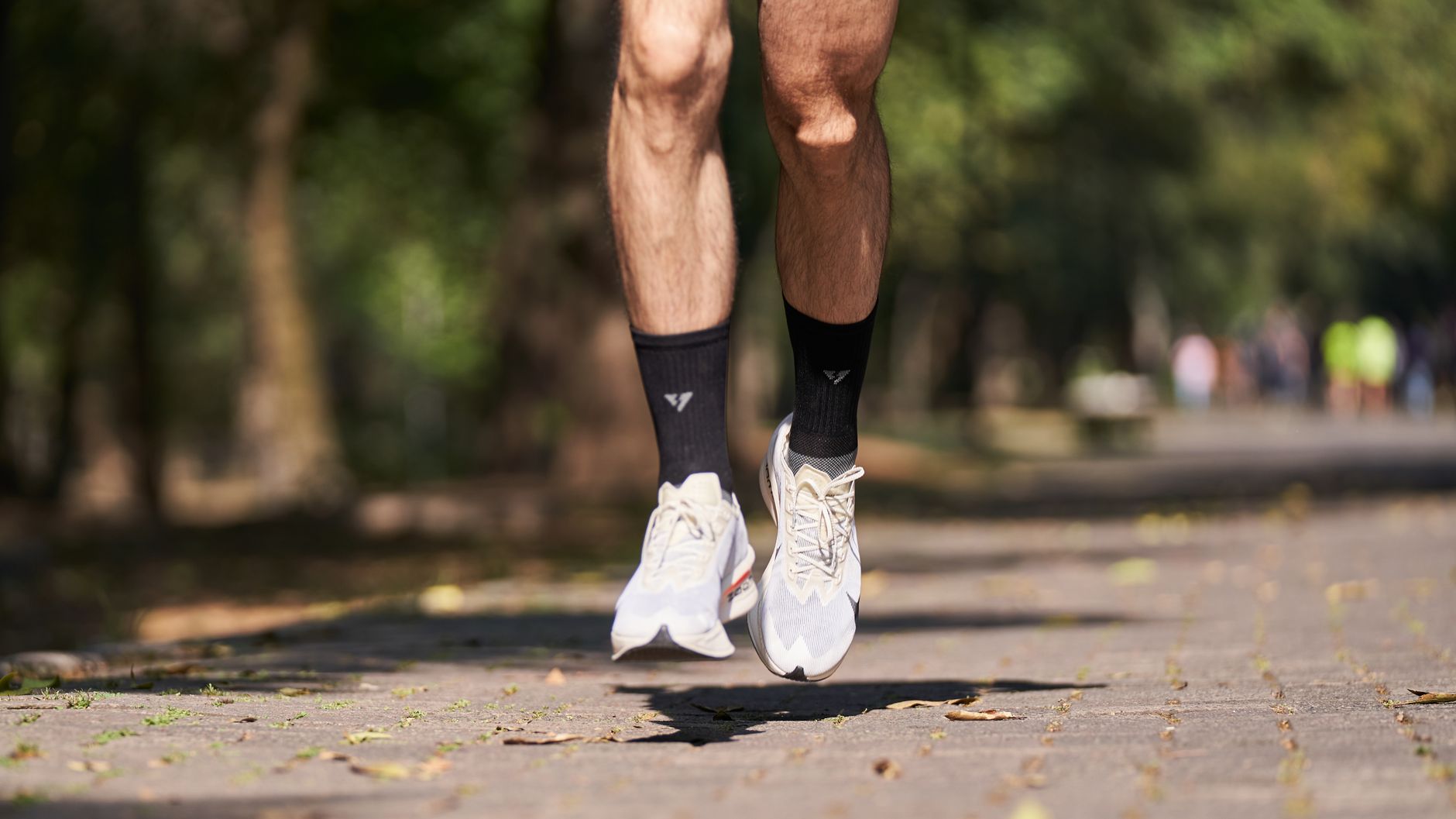
The most effective blister-prevention running socks combine seamless toe construction, moisture-wicking synthetic or merino blends, and anatomical left/right fit that eliminates excess fabric movement inside the shoe. Research shows friction and moisture—not cushioning thickness—are the two primary blister triggers runners can control through sock choice, with wet skin exhibiting approximately four times the friction coefficient of dry skin.
What causes blisters during running, and how do socks influence friction?
Blisters form when repetitive shear force separates skin layers, creating fluid-filled pockets between the epidermis and dermis. During running, this shear occurs at the interface between your foot and sock (or sock and shoe), with each footstrike generating micro-movements that accumulate over thousands of strides. The friction coefficient between skin and fabric increases roughly 4x when skin becomes wet—a phenomenon called maceration—which is why moisture management matters more than padding thickness.
Three controllable variables determine blister risk in your sock choice:
- Moisture accumulation: Sweat-saturated fabric both softens skin and increases drag against it
- Fit precision: Excess fabric bunches into pressure points; loose socks slide and create shear
- Material smoothness: Seams, thick stitching, and pilling create localized friction hot spots
Heat buildup compounds the problem by accelerating perspiration. A poorly fitted sock acts like sandpaper in slow motion—smooth when static, destructive under repetitive load. The goal isn’t eliminating all movement (impossible during gait), but transferring movement away from the skin surface to the sock-shoe interface where your body can’t feel it.
Which sock construction features prevent blisters most effectively?
Seamless toe construction eliminates the single highest-friction zone in traditional socks—the bulky horizontal seam across the toe box. True seamless socks use circular knitting (labeled “360° seamless”) with no seam at all, while linked-toe construction interlocks stitches rather than overlapping them, creating a flat profile under 1mm thick. Both work, but circular-knit designs provide the lowest measurable friction in lab testing.
Anatomical left/right design contours to each foot’s unique shape, preventing the fabric bunching that occurs when a symmetrical sock shifts during pronation. Look for these construction details:
- Compression zones at the midfoot arch that lock the sock in place without constricting circulation
- Targeted cushioning only where impact occurs—heel cup, forefoot ball, and optional Achilles tab—rather than uniform padding that adds bulk
- Y-heel construction that cups the heel pocket and prevents vertical slippage during toe-off
- Ventilation mesh panels over the dorsal foot where heat escapes but impact is minimal
Double-layer socks use a different strategy entirely: an inner hydrophobic layer (often CoolMax or polypropylene) that wicks moisture and moves with your foot, plus an outer layer (typically nylon or merino blend at 15-30% wool content) that moves with the shoe interior. The friction occurs between the two sock layers instead of at your skin—the same principle as moleskin or blister tape, but integrated into the fabric. This construction adds 2-3mm of thickness, so size shoes accordingly.
How should running socks fit to minimize blister risk?
Proper sock fit means snug contact across the entire foot surface without constriction—think “second skin” rather than compression garment. Heel slippage exceeding 3mm during gait indicates the sock is too large or the heel cup is poorly shaped. In the toe box, you want roughly 1cm of wiggle room beyond your longest toe when standing; less creates friction during toe-off, more allows bunching.
Sizing by foot length (measured heel-to-toe in centimeters) proves more reliable than shoe size, which varies by brand and model. Many technical running sock brands now use S/M/L sizing with 2-3cm length ranges—a men’s size 9-10 typically corresponds to 26-28cm foot length. The arch band should provide noticeable support without feeling like a tourniquet; if you see red marks deeper than 2mm after a run, size up.
Cuff height serves different purposes by distance:
- No-show (ankle): Reduces weight and heat for 5K-10K efforts in warm conditions
- Quarter-crew (mid-ankle): Balances protection and breathability for half marathons
- Crew (mid-calf): Prevents debris entry on trails and provides calf compression for ultras beyond 50K
The sock-shoe pairing principle matters more than most runners realize. Maximally cushioned shoes (stack height >35mm) pair best with thinner socks under 3mm to maintain ground feel and prevent the “marshmallow effect” that reduces proprioception. Firmer racing flats benefit from moderate sock cushioning (4-6mm) to offset the shoe’s minimal padding. When in doubt, match your sock thickness to your shoe’s firmness—cushioned shoes need thin socks, minimal shoes need thicker socks.
What materials wick moisture best during long runs?
Synthetic blends—typically polyester, nylon, and acrylic in varying ratios—transfer moisture at 200-300 grams per square meter per hour and dry in 20-40 minutes when removed. Merino wool blends (15-30% wool with synthetic fill) wick at 150-220 g/m²/hr and dry in 60-90 minutes, but provide superior temperature regulation and odor resistance during multi-hour efforts. Bamboo-derived fabrics fall between these ranges but lack durability after 50+ wash cycles.
The physics here involves hydrophobic versus hydrophilic fibers. Hydrophobic synthetics repel water at the molecular level, pushing moisture to the fabric surface through capillary action where evaporation occurs quickly. Hydrophilic merino absorbs moisture into the fiber core (up to 30% of its weight) then releases it gradually—slower drying but more stable comfort when conditions fluctuate.
Temperature thresholds guide material choice:
- Below 15°C: Merino blends excel by insulating even when damp
- 15-25°C: Either material works; choose based on distance (merino for 2+ hours)
- Above 25°C: Pure synthetics handle moisture volume better and dry faster between aid stations
Antimicrobial treatments like silver ion coating or Polygiene reduce odor-causing bacteria, but durability varies. Silver treatments typically survive 30-50 washes before effectiveness drops noticeably. Merino’s natural antimicrobial properties (lanolin residue) last the sock’s lifespan but require wool content above 20% to function. For multi-day stage races or ultramarathons where you’ll wear the same socks 12+ hours, antimicrobial treatment becomes essential rather than nice-to-have.
How do ultramarathon and trail runners choose blister-proof socks?
Distance beyond 50K shifts priorities from lightweight speed to sustained moisture control and mechanical protection. Ultrarunners typically choose merino blends with 30-50% wool content because synthetic-only socks saturate and lose wicking capacity after 4-6 hours of continuous sweating. The higher merino percentage maintains comfort even when soaked, while synthetic fibers provide structural integrity for 50-100 miles of impact.
Trail-specific features include debris guards—taller cuffs (mini-crew minimum) that prevent dirt, pebbles, and vegetation from entering the shoe collar during technical descents. Some ultras run through streams or require creek crossings; the water-crossing strategy involves accepting wet socks but changing into dry pairs at crew-accessible aid stations every 25-35K. Carrying backup socks in a waist pack adds 40-60 grams but can prevent race-ending blisters when conditions turn muddy.
For 100-mile events, the socks-and-gaiters integration matters. Low-profile trail gaiters (like Dirty Girl or OR Wrapid) attach to shoe laces and the sock cuff, requiring crew-height socks with reinforced cuff bands that won’t stretch or slip. Anatomical fit becomes even more critical at these distances—any pressure point that feels minor at 20 miles becomes excruciating by mile 60.
Elite ultrarunner gear lists from Western States and UTMB frequently show Darn Tough, Injinji (toe socks that separate each digit), and Swiftwick Pursuit models in the 30-40% merino range. The toe sock category deserves mention: by eliminating toe-to-toe friction, five-finger socks prevent interdigital blisters common in long descents, though the feel takes 3-5 runs to adapt to. Race-test any sock choice during training runs matching your goal event’s duration and terrain—a sock that works for road marathons may fail catastrophically on technical 50Ks with 2,000m of elevation change.
Frequently Asked Questions
Should I wear thick or thin running socks to prevent blisters?
Thinner socks (under 3mm cushioning) reduce heat buildup and work best in well-cushioned shoes, while moderate cushioning (4-6mm) suits firmer racing flats. The key is eliminating excess fabric that bunches—research shows friction, not padding, drives most blisters. Prioritize seamless construction and snug fit over thickness, then test both options during training runs to find your optimal shoe-sock pairing.
Do double-layer running socks actually prevent blisters?
Yes, when properly fitted. Double-layer socks create friction between their two fabric layers instead of at your skin, with studies showing 40-60% blister reduction in ultramarathons. The inner wicking layer moves with your foot while the outer layer moves with the shoe interior. They add 2-3mm bulk, so size shoes accordingly, and avoid them in temperatures above 28°C where heat retention outweighs friction benefits.
How often should I replace running socks to avoid blisters?
Replace socks every 300-500 kilometers or when you notice thinning fabric, loss of arch-band elasticity, or pilling that creates rough texture against skin. Worn socks lose seamless structure and moisture-wicking efficiency—the two primary blister defenses. Rotate at least three pairs to extend lifespan, as daily washing and drying degrades fibers faster than alternating pairs with 48-hour rest between wears.
Can merino wool socks prevent blisters in summer running?
Yes, if the blend contains 15-30% merino with synthetic fibers handling moisture transfer. Pure merino retains too much moisture above 25°C, but blended socks leverage wool’s odor resistance and comfort while synthetics manage sweat. Choose lightweight merino blends under 200g/m² with mesh ventilation zones for summer races. In temperatures exceeding 30°C, pure synthetics typically outperform any wool blend for blister prevention.
What’s the difference between seamless and flat-knit running socks for blister prevention?
Seamless socks use circular knitting with no toe seam, eliminating the most common friction trigger point. Flat-knit socks have a seam but use linked-toe construction where stitches interlock rather than overlap, creating a profile under 1mm versus 2-3mm in standard socks. Both work for blister prevention, but truly seamless construction (labeled “circular knit” or “360° seamless”) provides measurably lower friction beyond 15K distances. Check the toe box by feel—any noticeable ridge suggests blister risk.
Do compression running socks help prevent blisters?
Graduated compression at 15-20 mmHg can reduce blister formation by minimizing sock movement within the shoe, but only with precise sizing. Too-tight compression restricts circulation and increases friction; too-loose provides no stabilization benefit. Compression socks work best for runners with narrow heels prone to slippage. For blister prevention alone, anatomical fit and seamless construction matter more—treat compression as a secondary feature rather than the primary solution.
Leave a Reply