

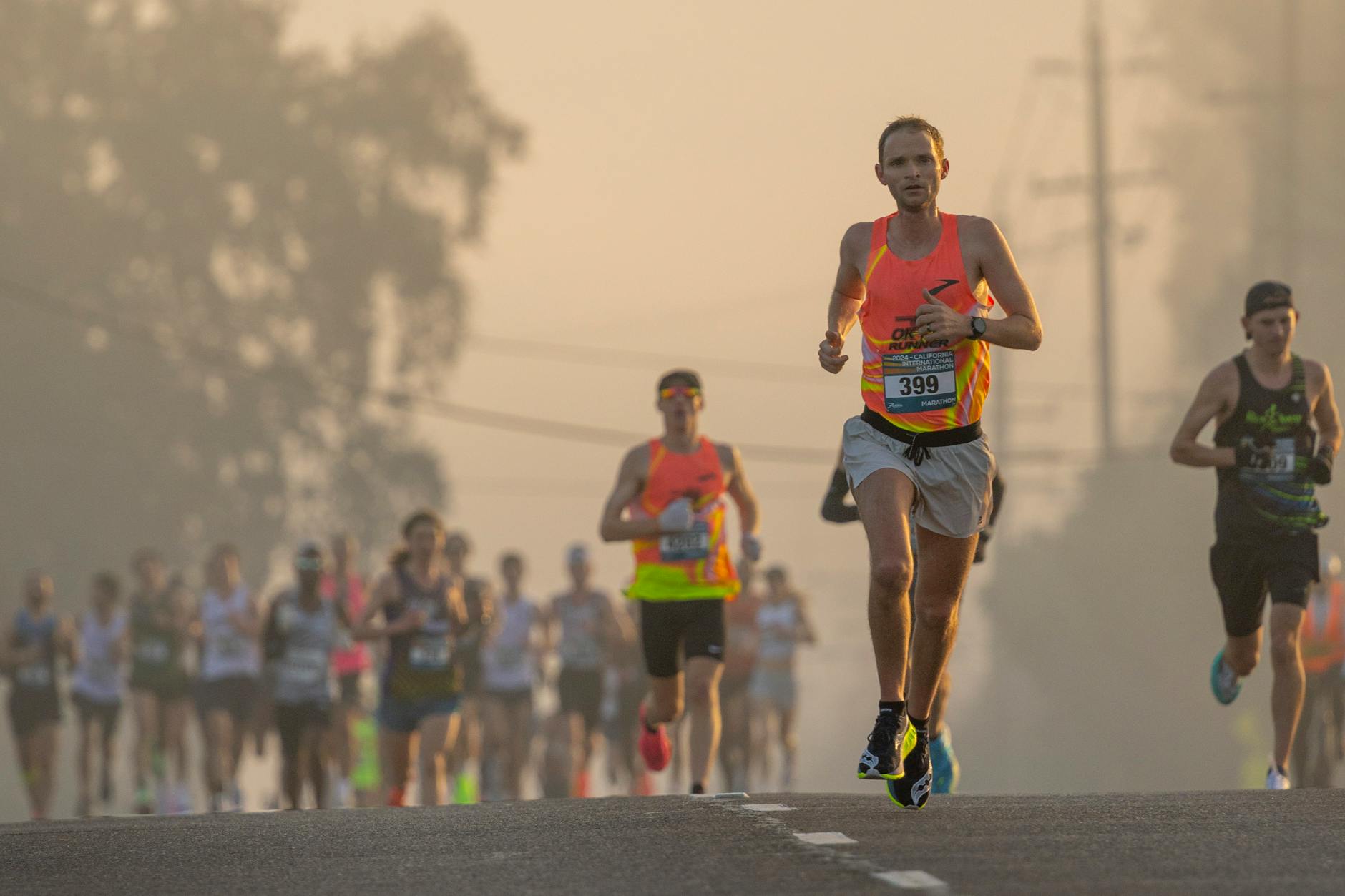
Elite 100-meter sprinters reach peak cadences of 240–260 steps per minute during maximum velocity, while marathon runners typically sustain 160–185 steps per minute across 42.2 kilometers. The dramatic difference reflects fundamentally different biomechanical demands: sprinters maximize power output and minimize ground contact time (under 100 milliseconds), while distance runners optimize oxygen economy and maintain sustainable ground contact (~200 milliseconds) that allows efficient force transfer without excessive metabolic cost.
What is the actual cadence difference between sprinters and marathoners?
The gap between sprint and marathon cadence spans roughly 60–100 steps per minute, creating distinct biomechanical profiles for each event. Elite 100-meter sprinters clock 240–260 spm during the acceleration and peak velocity phases—Usain Bolt’s cadence approached 260 spm at top speed during his 9.58-second world record, though it dropped to approximately 220 spm during the drive phase out of the blocks. Elite marathoners settle into a far steadier rhythm: Eliud Kipchoge maintains 185–190 spm during sub-2:02 performances, while most recreational marathoners run at 160–175 spm depending on pace and biomechanics.
Middle-distance events occupy the transitional zone. An 800-meter runner averages 200–210 spm, blending anaerobic power with moderate endurance, while 5K specialists typically maintain 185–195 spm. The cadence curve descends as race duration increases and the anaerobic contribution declines, creating a spectrum from explosive power to sustained economy.
| Event | Typical Cadence (spm) | Example Athlete | |——————|—————————|—————————| | 100m sprint | 240–260 | Usain Bolt (~260 peak) | | 800m | 200–210 | — | | 1500m / Mile | 195–205 | Jakob Ingebrigtsen (~200) | | 5K | 185–195 | Jakob Ingebrigtsen (~190) | | Marathon | 180–190 (elite) | Eliud Kipchoge (~188) | | Marathon | 160–175 (recreational) | — |
Measured cadence data from elite sprinters
Usain Bolt’s 2009 Berlin world record offers a vivid case study in sprint cadence dynamics. His turnover climbed from approximately 220 spm during the initial drive phase to a peak near 260 spm between 50 and 80 meters, where maximum velocity occurs. Shelly-Ann Fraser-Pryce, the women’s 100-meter standard-bearer, maintains 240–250 spm at top speed. Notably, cadence doesn’t remain constant: it rises through the acceleration zones, peaks during the maximum velocity window, and may drop slightly in the final 20 meters as neuromuscular fatigue accumulates and athletes struggle to maintain leg cycling speed against mounting lactate.
Sprint cadence also varies by phase. Out of the blocks, powerful drive mechanics dominate and cadence is lower. As the torso rises and stride mechanics transition to upright sprinting, cadence climbs sharply. The ability to sustain 240+ spm for even four to five seconds separates elite sprinters from the field.
Measured cadence data from elite marathoners
Eliud Kipchoge’s 2:01:39 Berlin marathon in 2018 was run at a remarkably consistent 185–190 steps per minute across all 42.2 kilometers. Brigid Kosgei’s 2:14:04 Chicago victory in 2019 showed similar stability, averaging approximately 180 spm. This consistency is a hallmark of elite marathon running—minimal cadence variation indicates neuromuscular resilience and finely tuned pacing.
Recreational marathoners present a different picture. Cadences of 160–175 spm are typical, often dropping further at slower paces or as fatigue mounts in the final 10K. The contrast underscores a critical point: elite marathoners don’t just run faster—they maintain higher turnover with only moderately longer strides, combining both variables to achieve sub-5:00/mile pace. A recreational runner at 9:00/mile pace with 165 spm takes shorter strides than an elite at 4:40/mile with 188 spm, but the elite athlete’s superior power and economy allow that higher cadence to feel sustainable rather than frantic.
Why does cadence increase so dramatically at sprint speeds?
Ground contact time collapses at maximum velocity, forcing rapid leg repositioning that drives cadence skyward. At marathon pace, runners maintain ground contact for approximately 200 milliseconds, allowing full force transfer through the foot and a controlled push-off. Sprinters at top speed contact the ground for just 80–100 milliseconds—less than half the duration—while spending 120–140 milliseconds airborne between steps. The physics are unforgiving: with such brief contact windows, sprinters must reposition the recovery leg and prepare for the next landing during a flight phase that barely exceeds one-tenth of a second.
Power output separates the two disciplines. Sprinters generate three to five times their body weight in vertical ground reaction force, a requirement that demands explosive muscle recruitment and rapid neural firing. Research by Weyand and colleagues in 2000 demonstrated that elite sprinters are distinguished not by longer strides but by shorter contact times—the ability to apply immense force in minimal time. Marathoners, prioritizing oxygen economy over maximum power, cannot sustain such force production for more than seconds without catastrophic lactate accumulation.
Ground contact time and the physics of maximum speed
At maximum velocity, the entire gait cycle becomes a race against time. Sprinters must swing the recovery leg forward, extend it for landing, absorb impact, generate propulsive force, and toe-off—all while the opposite leg completes the same sequence—in under 250 milliseconds per step. Contact time under 100 milliseconds limits how much force can be applied before the foot leaves the ground, so higher cadence becomes essential to maintain speed. If a sprinter attempted to lower cadence to 180 spm, the required increase in stride length would demand ground contact and flight durations incompatible with maximum power output.
Compare this to marathon mechanics: 200-millisecond contact allows the runner to load the achilles tendon, engage the calf and glute complex, and transfer energy through a controlled propulsive phase. The longer contact supports elastic recoil and metabolic efficiency, but it cannot coexist with the neuromuscular demands of sprinting at 10+ meters per second.
The role of stride length versus stride rate in speed
Speed is the product of cadence multiplied by stride length, but the two variables trade off in ways that constrain how athletes manipulate each. Elite sprinters achieve stride lengths of 2.4–2.8 meters at peak velocity—Usain Bolt famously covered approximately 2.77 meters per step during his world record. Multiply that by 240–260 spm and you arrive at roughly 10.4 meters per second (23.3 mph). Elite marathoners cover 1.2–1.5 meters per stride at 180 spm, yielding 3.6–4.5 meters per second (sub-5:00/mile pace).
Longer strides demand more airtime, greater hip extension, and higher power to overcome inertia with each landing. Shorter strides permit faster turnover but cover less ground per step, requiring higher cadence to achieve the same speed. Sprinters solve this with explosive strength that allows both long strides and high cadence. Distance runners, lacking that power reserve and needing to preserve glycogen for 26.2 miles, settle into a moderate stride length and cadence that minimizes the oxygen cost per meter traveled. For insights into how elite performances translate to everyday training, explore expert running guides and research that break down biomechanics into actionable frameworks.
How does oxygen cost shape cadence in distance running?
Running economy research reveals that cadence deviations of 5–10% above or below a runner’s self-selected rate increase oxygen consumption by 2–4%, a metabolic penalty that accumulates devastatingly over marathon distance. The landmark work by Cavanagh and Williams in 1982 demonstrated that runners naturally converge on a cadence that minimizes oxygen cost for their individual limb length, muscle fiber composition, and joint mechanics. Distance runners cannot afford to ignore economy—every milliliter of wasted oxygen per kilogram per minute translates to slower splits or earlier fatigue.
Sprinters operate in a different metabolic universe. Maximum velocity efforts last 6–10 seconds, fueled almost entirely by phosphocreatine and anaerobic glycolysis. Oxygen cost is irrelevant when the race ends before aerobic metabolism fully engages. Sprinters optimize for mechanical power, not metabolic efficiency, which is why forcing a marathoner to adopt sprint cadence would trigger ventilatory distress and lactate accumulation within minutes.
Recent data complicate the blanket prescription of 180 spm. Studies show that recreational runners forced into a cadence 10–15% above their natural rate often report higher perceived effort and worse economy. A 2018 meta-analysis by Van Oeveren and colleagues confirmed that self-selected cadence is frequently the most economical for a given runner, though small adjustments (5%) may reduce injury risk without sacrificing efficiency.
Why 180 steps per minute became the distance-running benchmark
Jack Daniels’ observation during the 1984 Olympics that elite distance runners averaged approximately 180 spm became one of running’s most repeated—and misunderstood—guidelines. Daniels noted the figure as a central tendency, not a biomechanical law. Over the past two decades, individual variation has proven far wider: elite marathoners range from 170 to 190 spm depending on leg length, footstrike pattern, and race conditions.
The 180 benchmark retains value as a diagnostic tool. Recreational runners at 155–165 spm often over-stride, landing well ahead of their center of mass and braking with each step. A 5–10% cadence increase can shorten stride length, reduce impact loading, and lower injury risk. But forcing a runner whose natural, economical cadence is 172 spm to hit 180 “because the elites do it” ignores the biomechanical reality that stride optimization is individual. Context: 180 reduces over-striding for many, but not a universal optimum.
What happens to cadence in the middle distances—800m to 5K?
Middle-distance events expose the gradual transition from power-dominant to economy-dominant physiology. An 800-meter runner sustains approximately 200–210 spm, reflecting the event’s dual demands: anaerobic power to survive the opening 400 meters and moderate aerobic capacity to finish the second lap. The 1500-meter and mile competitors drop to 195–205 spm as the aerobic contribution rises and sustainable pace becomes more critical than explosive speed.
By the 5K, cadence settles into the 185–195 spm range—closer to marathon rates than sprint rates—as runners prioritize oxygen economy and lactate clearance over maximum velocity. The 10K pushes cadence slightly lower still, averaging 180–190 spm among elites. Jakob Ingebrigtsen’s races illustrate this spectrum: his cadence hovers near 200 spm during championship 1500-meter finals but drops to approximately 190 spm in 5K track races, where sustained tempo and kick speed matter more than raw acceleration.
The trend is clear: as race duration extends and anaerobic capacity becomes less determinative, cadence declines and the metabolic cost per step becomes the limiting variable. For structured guidance on pacing across distances, check out training plans for every runner that incorporate cadence work alongside threshold and volume progression.
Should recreational runners try to mimic elite cadence patterns?
No single cadence target applies universally, and blindly mimicking elite turnover can backfire for runners with different biomechanics, strength levels, or injury histories. Recreational sprinters benefit from drills that emphasize rapid ground contact and explosive force application, but forcing a metronome-driven cadence of 240 spm during technique work risks mechanical breakdown if the athlete lacks the requisite power and coordination. Elite sprint cadence emerges organically from strength training, plyometrics, and max-velocity sprinting—not from consciously counting steps.
Recreational marathoners face a parallel risk. A runner whose self-selected cadence is 165 spm may experience worse economy, higher perceived effort, and even overuse injuries when forced to 180 spm without addressing underlying gait inefficiencies. The productive intervention is gradual cadence manipulation—5–10% increases over several weeks—paired with video gait analysis to ensure the adjustment reduces over-striding rather than simply shuffling faster.
Research supports cautious experimentation. A 2021 study found that a 10% cadence increase reduced impact loading in habitual over-striders, lowering peak tibial acceleration and ground reaction forces. But the same increase worsened running economy in athletes who already exhibited efficient landing mechanics. The lesson: use cadence as a diagnostic and corrective tool, not a one-size prescription.
Practical cadence experiments for distance runners
Start by establishing your baseline. Measure current cadence over three to five easy runs using your GPS watch’s cadence metric or a metronome app (count steps for 30 seconds, multiply by two). Most recreational runners land between 160 and 175 spm. Once you know your natural rate, increase it by 5%—if you’re at 170 spm, aim for 179 spm during 10-minute intervals within an easy run. Assess perceived effort, breathing rhythm, and any discomfort.
If the adjustment feels manageable after two weeks of interval work, extend the higher cadence to full easy runs, then tempo sessions. Track injury patterns, pace stability, and subjective fatigue. Avoid cadence jumps exceeding 10% in a single training block; abrupt changes alter loading patterns and can trigger achilles or calf issues. Video yourself from the side during these experiments—confirm that higher cadence shortens your stride and brings landing closer to your center of mass, rather than simply increasing leg churn without mechanical benefit.
When higher cadence makes sense for sprinters and when it doesn’t
Youth and novice sprinters benefit from drills that cue high cadence—fast feet exercises, A-skips at 200+ spm, and short acceleration buildups—to develop neuromuscular coordination and rapid leg cycling. These drills lay the foundation for efficient maximum velocity mechanics. But elite sprinters rarely manipulate cadence consciously during competition or max-effort training. Peak cadence emerges as a byproduct of power, elastic tendon properties, and ground contact efficiency developed through resisted sprints, wicket runs, and Olympic lifting.
Forcing cadence above an athlete’s natural maximum during the peak velocity phase risks mechanical breakdown: choppy strides, incomplete hip extension, and reduced force application. The training focus should remain on shortening ground contact time through strength and plyometric work—exercises like depth jumps, weighted sled sprints, and flywheel training that enhance rate of force development. When contact time drops organically from 110 milliseconds to 90 milliseconds, cadence climbs without conscious intervention, and speed follows.
How terrain, fatigue, and pace interact with cadence in distance running
Uphill running typically increases cadence by 5–10 steps per minute as runners shorten stride length to maintain effort and reduce the mechanical cost of lifting their center of mass against gravity. The adjustment is instinctive—longer strides uphill demand excessive knee lift and hip flexion, so the body compensates with faster turnover. Downhill running reverses the pattern: cadence often drops as stride length increases, creating a coasting effect that feels easier but concentrates impact forces and raises injury risk, particularly for the quadriceps and patellofemoral joint.
Late-race fatigue degrades cadence systematically. A study tracking Boston Marathon participants found an average cadence decline of 8 steps per minute between mile 20 and the finish as neuromuscular fatigue increases ground contact time and reduces the leg’s ability to rebound elastically. Elite runners with superior strength endurance show smaller declines—2–4 spm—while recreational athletes may lose 10–15 spm, compounding the pace slowdown already driven by glycogen depletion and central governor mechanisms.
Treadmill versus outdoor running introduces a subtle mechanical difference. Treadmill belts assist leg turnover by pulling the foot backward, reducing the need for active push-off and typically increasing cadence by approximately 3% at the same perceived effort. Runners may also unconsciously shorten stride on the fixed belt. For accurate cadence assessment and outdoor race preparation, measure your natural rate on roads and trails across varied terrain, then adjust treadmill sessions to reflect real-world mechanics rather than relying solely on belt-assisted turnover.
Frequently Asked Questions
What is the typical cadence for a 100-meter sprinter?
Elite 100-meter sprinters reach peak cadences of 240–260 steps per minute during the maximum velocity phase (50–80 meters). Usain Bolt’s cadence during his world-record run approached 260 spm at top speed, though it was lower (~220 spm) during the drive phase. Recreational sprinters typically range from 200–230 spm depending on speed and technique development.
Do elite marathoners really run at 180 steps per minute?
Elite marathoners typically run between 180–190 steps per minute, with athletes like Eliud Kipchoge averaging 185–190 spm during world-record performances. However, recreational marathoners often have lower cadences—160–175 spm is common. The ‘180 rule’ originated from 1984 Olympic observations but isn’t a universal optimum; individual anatomy and running economy determine the best cadence for each runner.
Why do sprinters have much higher cadence than distance runners?
Sprinters generate 3–5 times their body weight in ground force with contact times under 100 milliseconds, requiring rapid leg repositioning during flight phases of 120–140 milliseconds. Distance runners prioritize oxygen economy over maximum power, maintaining longer ground contact (~200 milliseconds) and minimizing metabolic cost, which naturally results in lower cadence. Research by Weyand and colleagues in 2000 showed elite sprinters are distinguished by shorter contact times, not longer strides, necessitating higher turnover.
Should I increase my running cadence to reduce injury risk?
A modest cadence increase of 5–10% can reduce over-striding and impact loading, particularly for runners who land well ahead of their center of mass. However, forcing a cadence significantly above your natural rate (often 170–175 spm for recreational runners) may worsen running economy and feel uncomfortable. Start with 5% increases during intervals, monitor comfort over two weeks, and use video analysis to assess landing mechanics rather than chasing an arbitrary number.
How does cadence change during a marathon as runners fatigue?
Studies of marathoners show cadence typically drops 5–15 steps per minute between mile 20 and the finish as neuromuscular fatigue increases ground contact time. Elite runners maintain more stable cadence due to superior strength and economy, while recreational runners may see sharper declines. Uphill sections can temporarily raise cadence 5–10 spm as stride length shortens, while downhill running often reduces cadence as stride lengthens, increasing injury risk.
What is the cadence range for middle-distance runners like 800m or 1500m?
Middle-distance runners occupy a transitional zone: 800-meter runners average 200–210 steps per minute, blending anaerobic power with moderate endurance demands. At 1500 meters and the mile, cadence drops to ~195–205 spm, and by the 5K it’s typically 185–195 spm. Athletes like Jakob Ingebrigtsen run ~200 spm in the 1500m but closer to 190 spm in 5K races, reflecting the shift from power-dominant to economy-dominant physiology.
Does running on a treadmill change my cadence compared to outdoor running?
Treadmill running typically increases cadence by approximately 3% compared to outdoor running at the same perceived effort, due to the moving belt assisting leg turnover and eliminating wind resistance. Runners may also unconsciously shorten stride length on the fixed belt. For accurate cadence assessment and training, measure your natural rate outdoors over varied terrain, then adjust treadmill sessions accordingly, recognizing the small mechanical difference.
Leave a Reply